More Than a Band: Teaching the Foundations of Field Biology
This summer, we have been spending time with Hobbitstee’s students introducing them to bird biology and the science of bird banding. There is a lot to learn. From the outside, bird banding can look deceptively simple. A bird is captured, identified, measured, fitted with a uniquely numbered band, and released. But those few minutes with a bird in hand rely on a much deeper understanding of biology, anatomy, molt, ageing and sexing, behaviour, data collection, research methods, animal welfare, and, perhaps most importantly, judgement.
That is why we have been taking our time. The objective has never been to see how many birds we can process in a morning. We began instead with the fundamentals: safe handling, understanding stress, learning the anatomy of a bird, becoming comfortable with measurements, recognizing feather generations and molt, accurately recording data, and understanding why each piece of information is being collected in the first place.
There is a natural desire when learning something new to become quick at it. Bird banding teaches almost the opposite lesson. First, you learn to be careful. Then you learn to be consistent. Speed comes much later.
A bird in the hand is not simply an opportunity to practise a technique. For those few moments it is a wild animal entirely dependent on us to make good decisions. Learning when to slow down, when to ask for help, and when the welfare of the bird outweighs the value of another measurement may be some of the most important lessons we can teach. The students have been doing exceptionally well. There is still an enormous amount to learn, as there is for anyone beginning in this field, but it has been rewarding to watch their confidence grow and to see individual pieces of information gradually begin to connect.
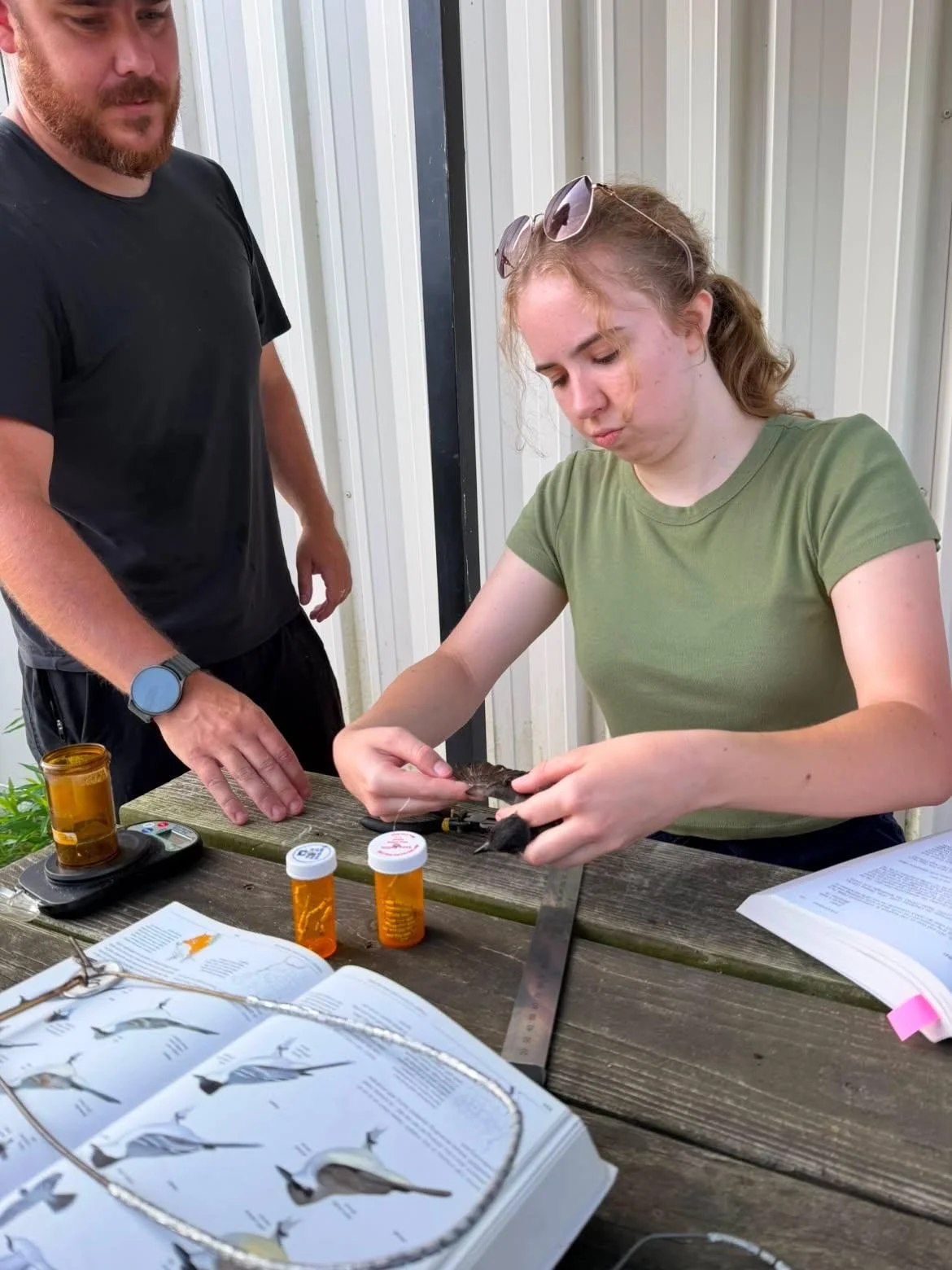
Hannah banding her first Eastern Kingbird.
What We Have Banded So Far
So far, the students have had the opportunity to work with 36 birds representing 12 species:
Song Sparrow -11
Gray Catbird -10
Common Yellowthroat -3
Least Flycatcher -3
Veery -2
American Goldfinch -1
Eastern Kingbird -1
House Wren -1
Nashville Warbler -1
Northern Waterthrush -1
Rose-breasted Grosbeak -1
Swainson’s Thrush -1
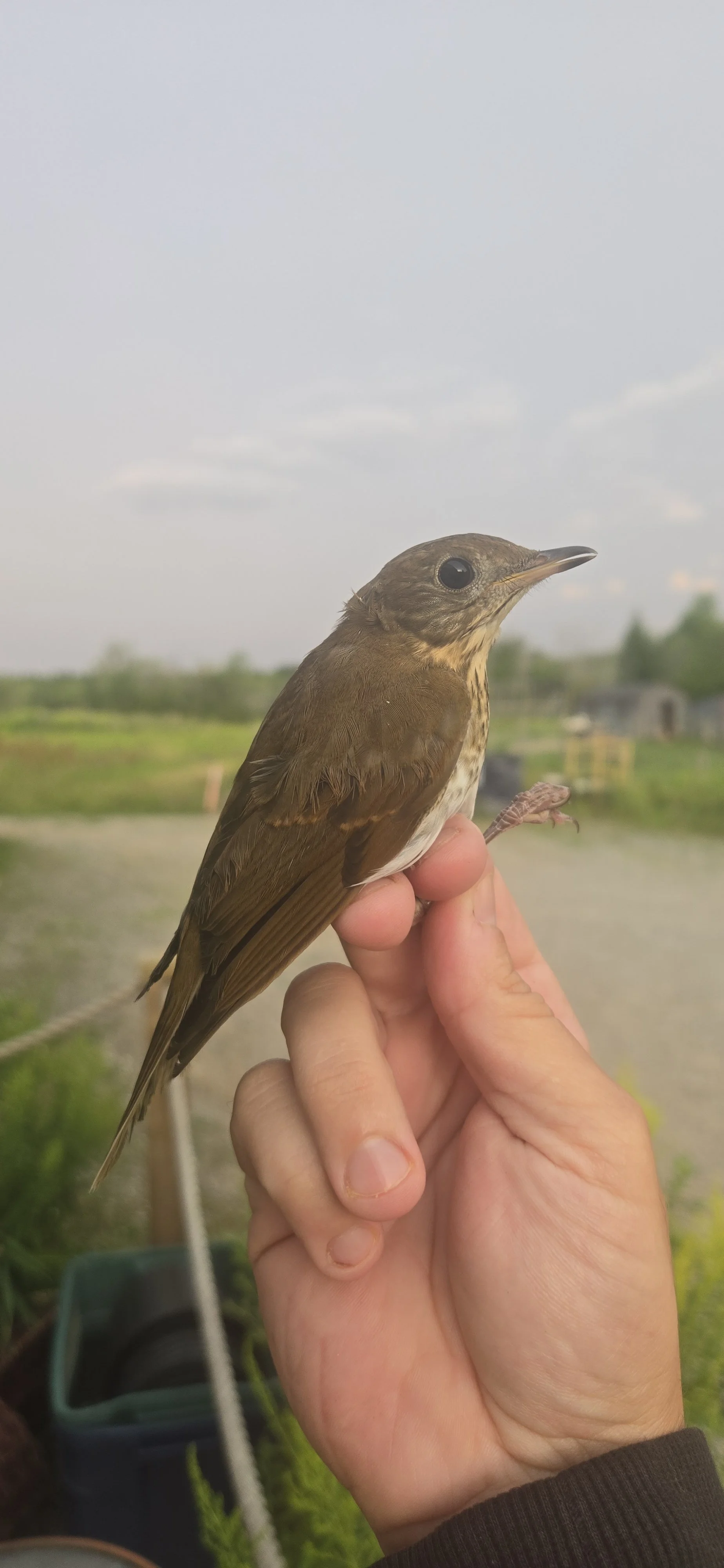
Veery
It is a modest number, deliberately so. At this stage, the value is not in accumulating hundreds of banding records. It is in having enough time with each bird to ask questions, look carefully, make mistakes under supervision, discuss what we are seeing, and understand how we arrived at a conclusion.
A Gray Catbird and a Song Sparrow may become familiar relatively quickly. A flycatcher asks different questions. A thrush presents another set of challenges. Then a Nashville Warbler appears, and suddenly the discussion shifts again.
Every bird adds another small piece to their understanding.
Is Bird Banding Still Relevant?
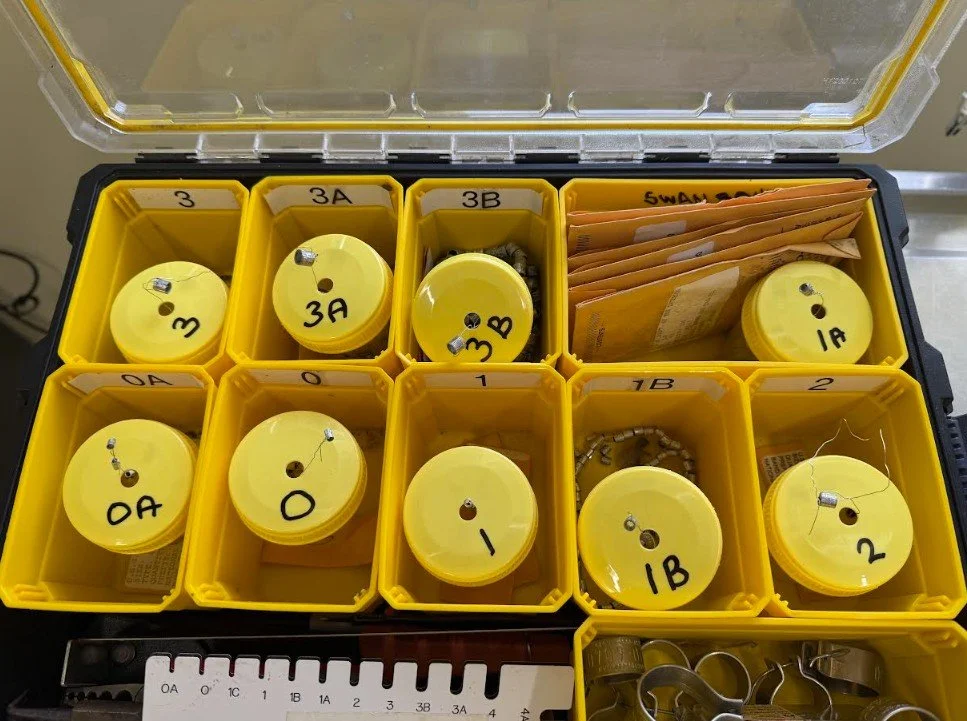
Our gear.
It is also worth being candid about bird banding itself.
Bird banding is an old science.
The fundamental idea has changed remarkably little in more than a century: band an individual bird, release it, and use information obtained later to learn something about its movements, survival, longevity, or population.
Modern wildlife research can now do things that the early pioneers of bird banding could hardly have imagined. GPS and satellite transmitters can follow individual animals across continents. Automated telemetry networks can detect movements without somebody ever having to recapture the bird. Acoustic monitoring, genetics, stable isotopes, remote sensing, and increasingly sophisticated analytical methods allow researchers to study wildlife at scales that conventional banding alone simply cannot provide.
For some questions, traditional bird banding is no longer the most effective tool. In some applications, it could reasonably be described as outdated. And I think there is value in acknowledging that rather than pretending otherwise.
But there is an important distinction between an old technique and an obsolete education.
Because beneath the physical act of placing a band on a bird are many of the fundamental skills on which good field research is built. Banding teaches you to observe carefully. It teaches you that data have to be collected consistently if they are going to mean anything later. It teaches you to understand variation between individuals rather than expecting biology to fit perfectly into a field guide. It teaches you to recognize uncertainty and to be comfortable saying, I don't know. It teaches you that every measurement should exist for a reason. And eventually, it forces you to ask one of the most important questions in science.
What are we actually trying to learn?
That question leads naturally into study design, sampling, bias, replication, data quality, animal welfare and, ultimately, whether the method you have chosen is capable of answering the question you started with. Those principles do not become obsolete when the technology changes. They are the building blocks of research.
Why We Are Doing This at Hobbitstee
That is really where this program begins to connect with the larger work at Hobbitstee. The goal is not to create banders simply for the sake of banding birds. We want to begin developing the biological and research capacity to ask better questions about the animals that pass through Hobbitstee's care. Wildlife rehabilitation necessarily focuses enormous effort on getting an animal to the point where it can be released. But release itself is not the end of the biological story.
What happens the following day?
A month later?
Does that bird successfully reintegrate into the wild? Does it migrate normally? Does it survive? Where does it go? Are there aspects of rehabilitation that influence those outcomes, and can what we learn ultimately help us make better decisions for future animals?
Those are much more difficult questions. Answering them will require more than bird bands. It will require thoughtful study design and, where appropriate, the integration of tools such as telemetry, tracking technology and other modern research methods. But before you can build good research, you need people who understand how biological information is collected in the first place. That is why we are starting here.
A bird in the hand. A set of measurements. A question. A hypothesis. A carefully recorded observation.
The fundamentals first.
The larger questions can grow from there.
Coming Back to It
There has also been a more personal side to this summer that I did not entirely expect. There was a period of my life when bird banding was almost second nature to me. I spent countless hours around mist nets and banding tables and handled thousands of birds. Eventually, my work moved in other directions, and it had been years since I had regularly done some of this. Coming back to it has, at times, felt strangely foreign.
There are things I once did almost without thinking that I now catch myself consciously working through again. A feather pattern I know I recognize but have to search my memory to place. An ageing criterion that feels familiar long before I can remember exactly why.
Then, little by little, it comes back.
The way a particular species feels in the hand. The subtle differences between generations of feathers. The reasoning that turns several small observations into an age determination. The rhythm of working through a bird carefully before opening your hand and watching it return to the trees. And with it has come the realization that I missed this more than I knew.
Perhaps what I have enjoyed most, though, is no longer simply doing it myself.
It is teaching it.
There is something special about watching somebody begin to see what you once had to be taught to see. A feather stops simply being a feather and becomes evidence of molt and history. A measurement stops being a number and becomes a piece of a larger biological question. A bird stops being only something beautiful in the hand and becomes a glimpse into migration, survival, ecology and a life that will continue almost entirely beyond our view.
None of us learn these things alone. I was fortunate to have people who took their time with me, answered countless questions, corrected my mistakes, and trusted me with knowledge they had spent years accumulating. Years later, I find myself on the other side of that exchange.
The bands we put on these birds may someday produce another record. Some may never be encountered again. But that was never the only thing we were putting into the field this summer.
We were passing knowledge forward. And if these students carry even some of it into their own careers as biologists, conservationists and researchers, that knowledge may ultimately travel much farther than any bird we band.
