Beyond Release
Avitura and Hobbitstee Are Conducting Post Release Study!
Release is often treated as the final measure of success in wildlife rehabilitation. After treatment, recovery, conditioning, and careful assessment, a bird is returned to the wild and the immediate objective has been achieved. From a scientific perspective, however, release is not the conclusion. It is the point at which some of the most important questions begin. Does the bird survive the first days and weeks following release? Does it resume normal hunting and movement behaviour? Does it return to familiar habitat, establish itself somewhere new, or continue a seasonal migration? Are outcomes influenced by the original injury, the length of rehabilitation, the age of the bird, the time of year, or the location selected for release?
Avitura is partnering with Hobbitstee Wildlife Refuge to develop a long term post release study focused initially on American Kestrels, Red-tailed Hawks, and Rough-legged Hawks. As the project develops, we intend to expand the research to include other raptor species that are regularly admitted for rehabilitation. The purpose of the study is to better understand how rehabilitated birds survive, move, and behave after returning to the wild. By connecting rehabilitation records with observations collected after release, we hope to develop evidence that can be used to evaluate current practices and improve outcomes for future patients.
Who Is Hobbitstee?
(Hobbitstee Wildlife Refuge) is a wildlife rehabilitation centre operated by Chantal Theijn and dedicated to the care, recovery, and release of injured, orphaned, and displaced native wildlife. Through specialized treatment, careful assessment, and extensive practical experience, Hobbitstee works to give each animal the strongest possible opportunity to return successfully to the wild.
Chantal and the Hobbitstee team manage a diverse range of wildlife cases, including many of the raptors that will form the initial focus of this research. Their detailed knowledge of each bird’s admission, injuries, treatment, recovery, conditioning, and readiness for release provides the essential foundation for the study.
The partnership brings together two complementary areas of expertise. Hobbitstee will continue to lead the rehabilitation and release of participating birds, while Avitura will support auxiliary banding, post release monitoring, data collection, public reporting, and the eventual introduction of telemetry.
Together, the organizations aim to move beyond assuming that release represents a successful outcome. By following rehabilitated birds after they return to the wild, the partnership will begin building the evidence needed to evaluate survival, identify patterns, refine rehabilitation practices, and contribute to stronger standards of wildlife care.
Why Does Post Release Monitoring Matter?
Wildlife rehabilitation centres collect extensive information while an animal is in care. Records may include the cause of admission, the nature and severity of an injury, treatment history, recovery time, body condition, flight performance, and behavioural assessments.
This information is essential for determining whether a bird is ready to return to the wild. What it cannot tell us is what happens afterward. A bird may leave the release site and resume normal behaviour almost immediately. Another may struggle to hunt, move unusually, remain close to the release area, or experience complications that were not apparent during rehabilitation. Without post release monitoring, these outcomes may never be documented.
A successful release should involve more than the ability to leave a carrier and fly from sight. It should also include survival, appropriate movement, normal behaviour, and the ability to function independently in the wild.
Collecting this information can help determine whether current rehabilitation practices are producing the intended results. It may also reveal opportunities to improve treatment, physical conditioning, behavioural assessment, release timing, habitat selection, and the criteria used to determine whether a bird is ready.
How Will Our Study Work?
The first stage of the study will use coded auxiliary leg bands.
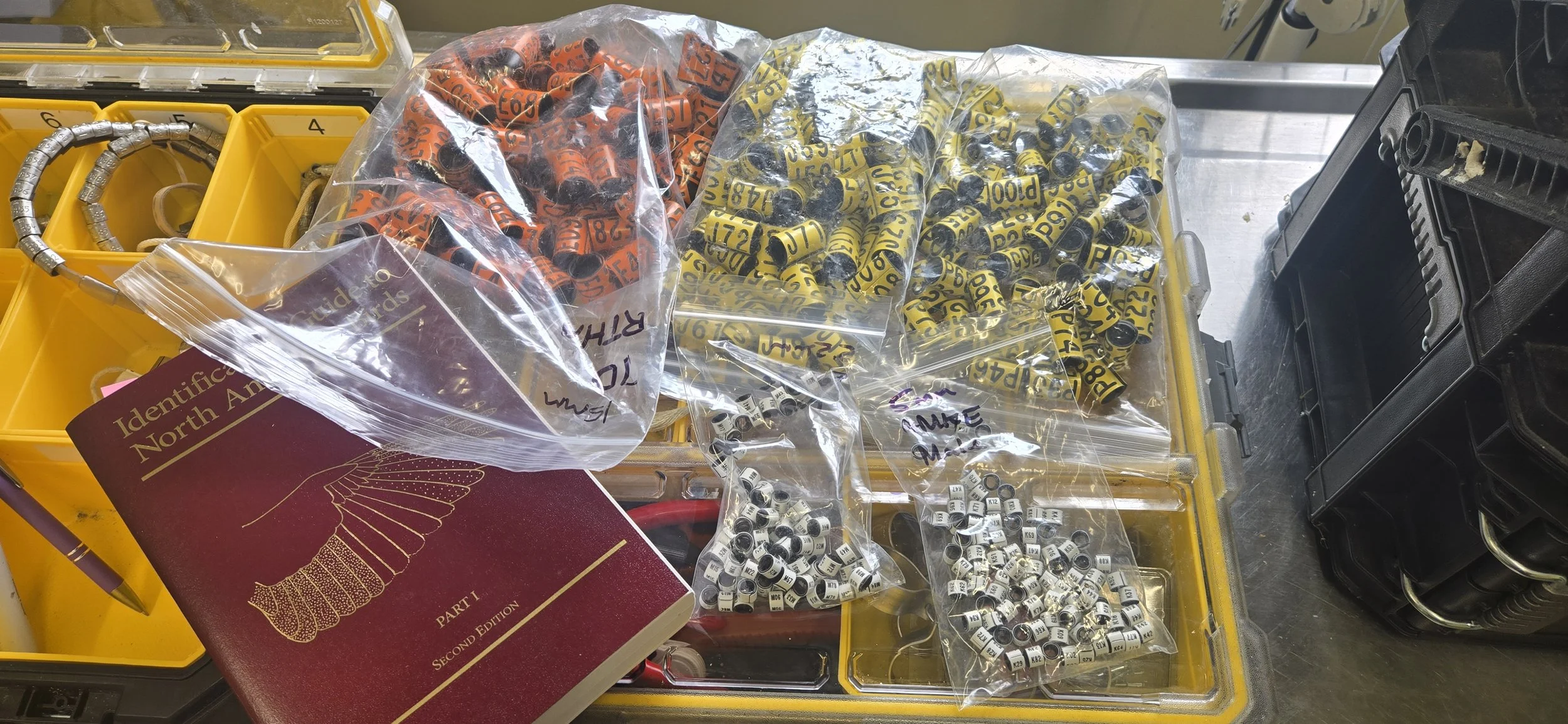
Auxilliary Bands
A standard federal bird band contains a unique identification number, but the number is generally too small to read unless the bird is captured again or recovered. An auxiliary band is larger and uses a visible colour and letter or number combination that may be read through binoculars, a spotting scope, or even a photograph. This allows an individual bird to be identified without needing to capture it again. Each bird will receive a unique code linked to its rehabilitation and release records. When that bird is observed again, information such as the date, location, behaviour, apparent condition, and surrounding habitat can be documented.
A single observation may confirm that a bird survived for a particular period following release. Repeated observations can provide a more complete history of its movements, habitat use, migration, territorial activity, and ability to persist over time. For example, auxiliary band reports may help determine whether a bird remained near its release site, returned to a previous territory, travelled a considerable distance, or appeared elsewhere within its expected range. They may also document behaviours such as hunting, migration, interaction with other birds, or the use of suitable habitat.
Understanding the Limits of Band Sightings
Auxiliary banding is a valuable research tool, but it does not provide continuous tracking. A bird that is not observed again cannot be assumed to be either dead or alive. Until further evidence appears, it occupies a slightly Schrödingerian category: not lost, not confirmed, simply unknown. It may have dispersed into an area with fewer observers, moved onto private property, occupied remote habitat, or simply remained undetected. Band resightings therefore reflect both whether a bird survived and whether someone had a reasonable opportunity to see and report it. These limitations must be considered when the data are interpreted. Even so, auxiliary bands allow a relatively large number of birds to be monitored at a manageable cost. They also create an important role for birders, photographers, landowners, and wildlife professionals. A clear photograph or carefully documented band code may provide the first evidence that a bird survived, migrated, returned to a territory, or established itself in suitable habitat. As more observations are collected across multiple birds and seasons, those individual records can begin to reveal broader patterns.
The Next Step: Telemetry
As the study develops and funding becomes available, Avitura and Hobbitstee intend to introduce telemetry for selected birds. Telemetry uses a small tracking device to collect information about an animal’s location or movement. Depending on the species, body size, study question, expected movement, and available technology, this may involve conventional radio transmitters, automated receiving networks, GPS units, cellular systems, or satellite tracking. Telemetry can answer questions that band sightings alone cannot. It may show where a bird travels immediately after release, how far it moves each day, which habitats it selects, whether it establishes a normal home range, and when it begins migrating. It may also help distinguish between a bird leaving the study area, a transmitter failing, and a probable mortality event. This information is especially valuable during the first days and weeks following release, when a bird is transitioning from rehabilitation to independent survival. One bird may leave the release area quickly and resume expected movements. Another may remain unusually close to the site or demonstrate limited activity. These differences may provide important insight into the effectiveness of physical conditioning, release timing, release location, and other rehabilitation practices. For migratory species, telemetry may also allow researchers to document movement across a much larger geographic area. It may reveal migration routes, stopover locations, wintering areas, and the timing of seasonal movements that would be difficult or impossible to document through visual observations alone.
Responsible Use of Tracking Devices
Tracking devices must be used carefully and only when the scientific value of the information justifies their use. Device weight, attachment method, expected deployment period, species behaviour, and the potential effects on flight, hunting, and natural movement must all be considered. Not every bird will be an appropriate candidate for telemetry. For this project, devices will only be used when the method is suitable for the species and individual bird, the research question is clearly defined, and all necessary permits, approvals, and animal welfare requirements have been met. The objective is to collect meaningful information while minimizing any influence on the bird’s ability to behave naturally.
Why Begin with These Species?
American Kestrels, Red tailed Hawks, and Rough legged Hawks provide a useful starting point because they differ in size, behaviour, habitat use, and seasonal movement.
American Kestrels are small falcons associated primarily with open habitats. Depending on the individual and season, they may remain within a local area, disperse across a wider region, or migrate.
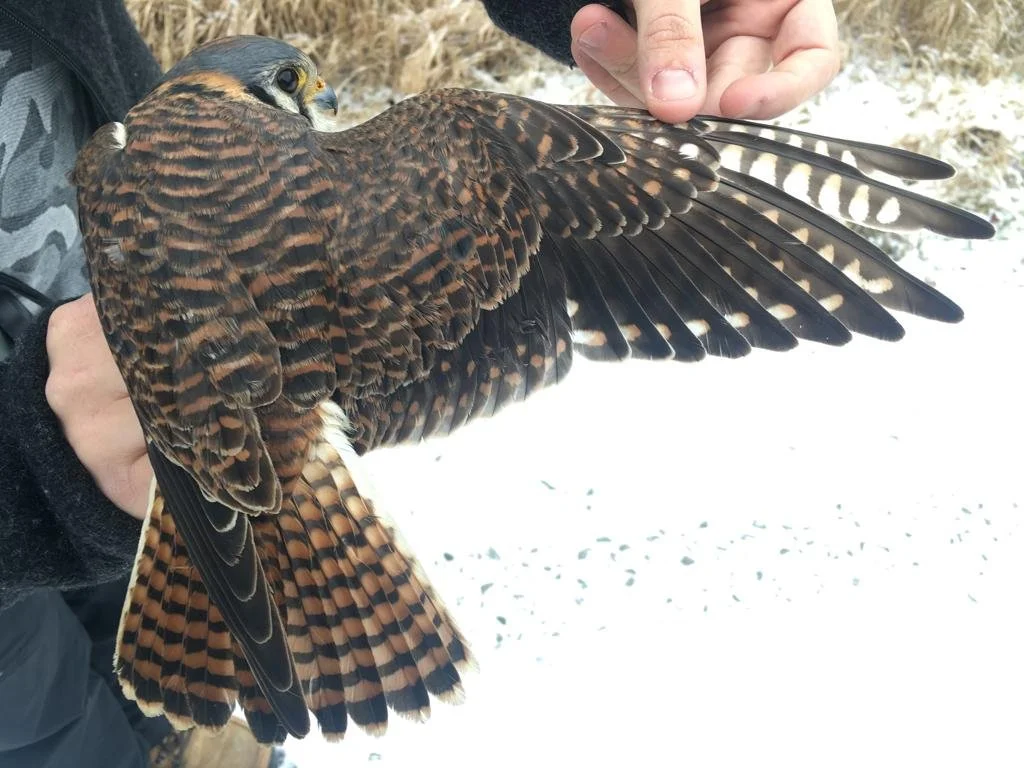
Female American Kestrel
Red-tailed Hawks are larger and may be resident, locally mobile, or migratory. Their size, visibility, and frequent use of open landscapes may also increase the likelihood that auxiliary bands can be observed and reported.
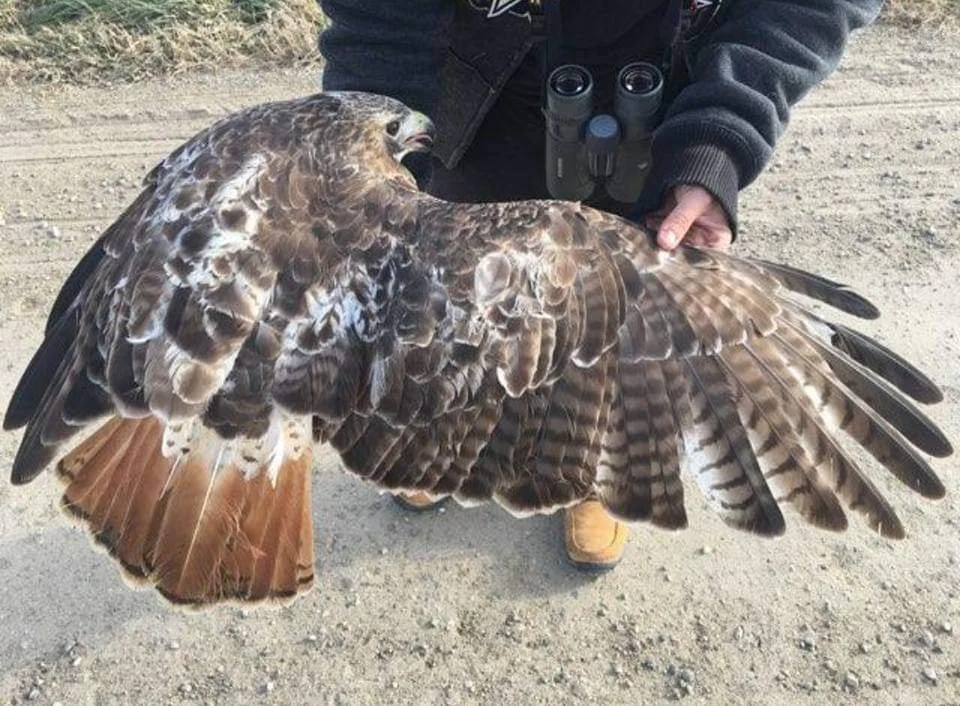
Red-tailed Hawk
Rough-legged Hawks are long distance migrants that breed in northern regions and winter across southern Canada and the United States. Monitoring rehabilitated individuals may provide information about both their local adjustment following release and their subsequent migration.
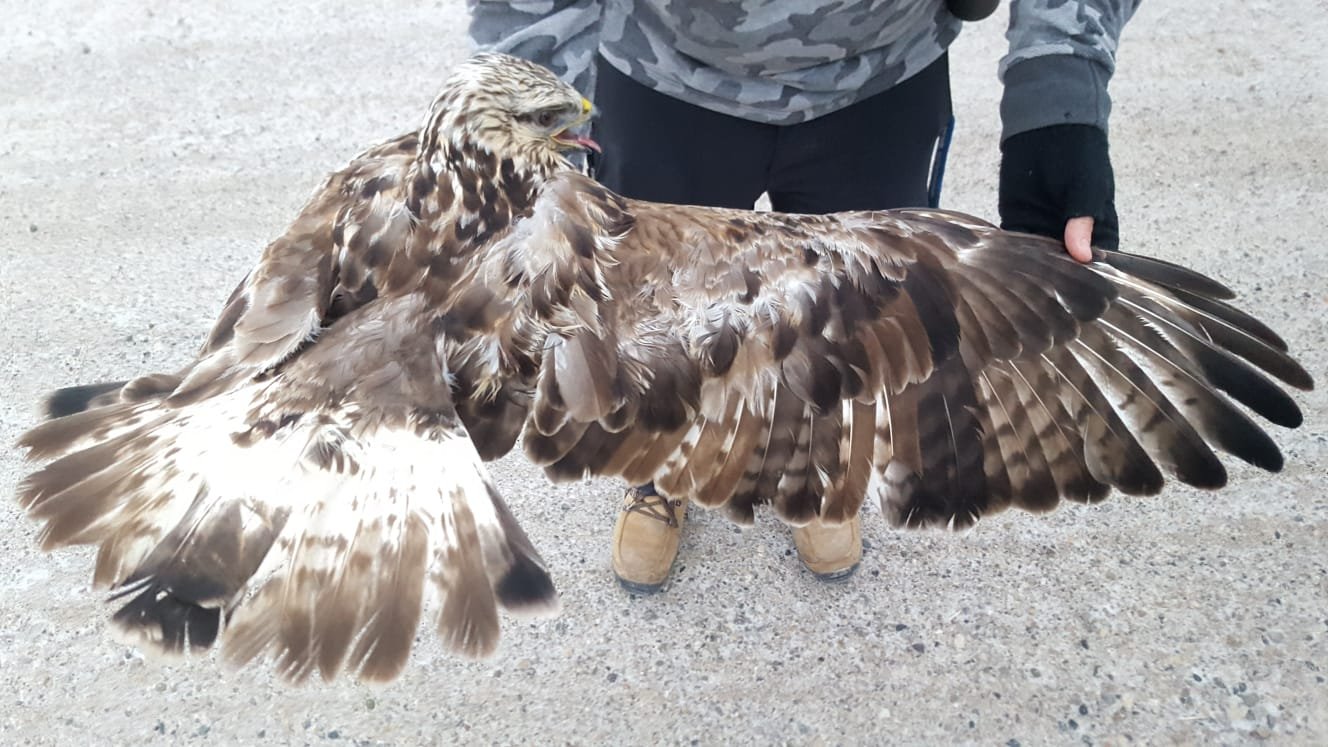
Rough-legged Hawk
Together, these species will allow the study to examine different ecological strategies and evaluate monitoring methods across a range of body sizes, habitats, and movement patterns. As the program becomes established, the study may expand to include additional raptor species that are regularly treated and released by Hobbitstee.
Connecting Rehabilitation with Life After Release
The greatest scientific value of the project will come from connecting post release observations with the information collected during rehabilitation. Potential variables may include the cause of admission, age, sex where known, injury type, injury severity, treatment provided, length of rehabilitation, body condition, flight performance, behavioural assessment, release date, release location, season, weather conditions, subsequent observations, telemetry detections, and confirmed survival or mortality information. As the number of monitored birds grows, these records may allow meaningful comparisons to be made. Does the length of time spent in rehabilitation influence movement following release? Do adults and younger birds show different outcomes? Are birds released near their original capture location more likely to resume normal activity? Are certain injuries associated with reduced survival even when the bird appears to meet current release criteria? These questions cannot be answered through one bird or one season.
Meaningful conclusions will require consistent methods, careful interpretation, and information collected over many years. Early results will need to be treated cautiously, particularly where sample sizes are small or detection rates are limited. The objective is not to force simple conclusions. It is to build a reliable body of evidence.
The purpose of the project is not to prove that existing methods are correct. It is to evaluate them. When birds survive and return to normal movement and behaviour, the findings can provide evidence supporting the rehabilitation and release practices being used. When outcomes are inconsistent or poor, the information may identify areas where changes should be considered. Those changes could involve treatment methods, physical conditioning, behavioural assessment, release timing, habitat selection, release location, monitoring intensity, or the management of particular injuries. Over time, the findings may help Hobbitstee refine its own practices and contribute to broader discussions about how rehabilitation success should be measured.
This is applied wildlife science. Each band sighting, movement record, telemetry detection, and confirmed outcome becomes part of a larger effort to improve care for future patients.
How Birders and the Public Can Help
Public observations will be an important component of the auxiliary banding program. Birders, photographers, landowners, and wildlife professionals may be the first people to relocate a marked bird following release. When the project begins, Avitura and Hobbitstee will publish clear information about the band colours, identification codes, participating species, and reporting process. Observers should never approach, flush, bait, or disturb a bird to obtain a band code. Reports should be made from an appropriate distance using binoculars, spotting scopes, or photography. A useful report may include the date and location, the species, the colour of the band, the complete or partial code, a photograph where possible, and notes about the bird’s behaviour or apparent condition. Even an incomplete report may provide valuable information.
Building the Project
The first phase of the study will focus on establishing the auxiliary banding program, standardized data collection, a public reporting system, and a long term database. The next stage will involve securing the funding, equipment, permits, approvals, and technical support required to introduce telemetry. A portion of the proceeds from Avitura experiences offered in Ontario will be contributed directly to this initiative. These contributions will help support auxiliary bands, tracking equipment, field monitoring, data management, and the eventual expansion of the study.
Avitura will also share selected stories from individual birds as the project develops. These accounts will follow birds from their admission to Hobbitstee through treatment, recovery, release, and any subsequent observations or tracking information. These stories will be grounded in documented evidence. Some birds may be observed repeatedly. Others may travel far beyond the reach of local monitoring. Some may provide clear evidence of successful rehabilitation, while others may reveal limitations, unexpected outcomes, or new questions.
